Wait Right There!
Limited-Time Opportunity!
$1 Gets You Access To "The 100: Gospel Grammar System" & 1,000+ Hours Of Song Tutorials!
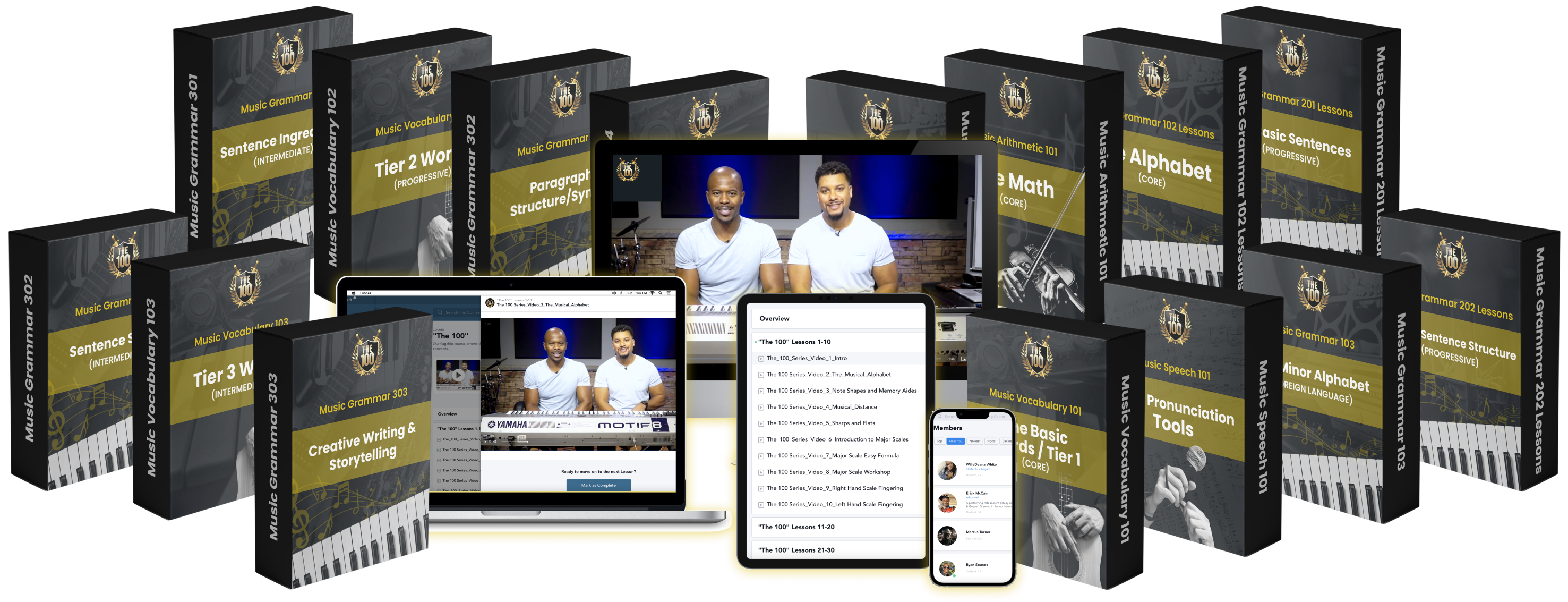

The Gospel Music Training Center was designed with the starter in mind. This is a level we designate right before "beginner" and take the time to introduce you to the notes on the piano, how they're named, their relationship and shape, memory aides, and more.
Simply put, you need no prior experience to join the Gospel Music Training Center. When you log in, the "Foundations of Gospel Music" course will be waiting to take you from the very beginning.
If you're experienced already, there are hundreds of lessons and courses waiting for you to take you to the next level. This platform covers it, A-Z.
Our program is designed to have you playing simple one-fingered melody and basic chord songs within 8 weeks.
You'll be playing major scales, while working on your coordination and dexterity, within a couple weeks. Depending on your commitment level, you can move on to playing full-sounding songs in as early as a few months.
Much of it will not depend on the knowledge, as learning chords and patterns are easy concepts to grasp. The challenge is making your fingers do what your mind knows. This takes time and repetition.
Since the program is self-paced, some students find themselves soaking up the material like a sponge and progressing at an accelerated pace. These are the students who typically dedicate hours a day to practicing.
Other students who do this as hobby, progress at a pace that would have them playing a variety of songs competently in 6-12 months.
Music Grammar 101 - "The Letters" (Notes)
1 - Course Introduction
2 - The Musical Alphabet
3 - Note Shapes & Memory Aides
4 - Musical Distance 101: Half Steps & Whole Steps
5 - Sharps & Flats
Music Grammar 102 - "The Alphabet" (Scales)
6 - Introduction to Major Scales
7- Major Scale Easy Formula
8 - Major Scale Workshop (All 12 Keys) 
9 - Major Scale Right Hand Fingering
10 - Major Scale Left Hand Fingering
Music Arithmetic 101 - "The Math" (Numbers & Intervals)
11 - The Number System Explained
12 - Number System Mastery
13 - Musical Distance 102: Perfect Intervals
14 - Musical Distance 103: Major & Minor Intervals
15 - Musical Distance 104: Diminished & Augmented Intervals
Foreign Language 101 - "The Minor Alphabet" (Minor Scales)
16 - Introduction to Relative Minor
17 - Introduction to Minor Scales
18 - Minor Scale Workshop (All 12 Keys)
19 - Minor Scale Right Hand Fingering
20 - Minor Scale Left Hand Fingering
Music Speech 101 - "Daily Pronunciation Tools" (Rhythm)
21 - Introduction to Rhythm
22 - Introduction to Circle of Fifths
23 - Circular Scale Exercises For Dexterity
24 - Introduction to Hanon Exercises
Music Vocabulary 101 - "The Basic Words / Tier 1" (Triads)
25 - Introduction to Chords
26 - Major Triads
27 - Minor Triads
28 - Diminished Triads
29 - Augmented Triads
30 - Chord Inversions
31 - Primary Chords
32 - Secondary Chords = Backing track and/or midi file available
Music Grammar 201 - "The Basic Sentences" (Primary Patterns)
33 - Introduction to Chord Progressions
34 - Basic 1-4-5 Chord Progression ("Hallelujah")
35 - Inverted 1-4-5 Chord Progression ("Hallelujah")
36 - Inverted 1-4-5 Chord Progression w/ Secondary Chords ("Hallelujah")
Music Grammar 202 - "Simple Sentence Structure" (Chord Placement)
37 - Diatonic Chords
38 - Diatonic Chords In All 12 Keys
39 - Diatonic Chord Exercise
40 - Diatonic Chord Roles
41 - Harmonizing the Scale with Chords
42 - Harmonizing the Scale with Chords In All 12 Keys
Extended Music Vocabulary 102 - "Tier 2 Expanded Words" (Seventh Chords)
43 - Introduction To Seventh Chords
44 - Chord Qualities vs Quantities
45 - Major Seventh Chord
46 - Minor Seventh Chord
47 - Dominant Seventh Chord
48 - Diminished Seventh Chord
49 - Half-Diminished Seventh Chord
50 - Seventh Chord Inversions
51 - Seventh Chord Inversion Exercise
Music Grammar 301 - "Sentence Ingredients" (Seventh Chord Placement)
52 - Diatonic Seventh Chords
53 - Diatonic Seventh Chords In All 12 Keys
54 - Seventh Chord Skeletons
55 - Diatonic Seventh Chord Skeletons In All 12 Keys
56 - Secondary Dominant Chords
57 - Common Chord Inversions & Replacements
Music Grammar 302 - "Sentence Syntax" (Chord Progressions)
58 - Introduction To Circular Chord Progressions
59 - 2-5-1 Skeleton Chord Progressions
60 - Stepwise Motion Chord Progressions
61 - Chromatic Chord Progressions & Passing Chords
62 - Introduction To Circular Passing Chords
63 - Borrowing Major 2-5-1 Progressions From Other Keys
64 - Borrowing Minor 2-5-1 Progressions From Other Keys = Backing track and/or midi file available
Music Vocabulary 103 - "Tier 3 'S.A.T.' Words" (Extended Chords)
65 - Major Ninth Chords
66 - Minor Ninth Chords
67 - Dominant Ninth Chords
68 - Where To Use Ninth Chords
69 - Major Eleventh Chords
70 - Minor Eleventh Chords
71 - Dominant Eleventh Chords
72 - Where To Use Eleventh Chords
Music Vocabulary 104 - "Tier 4 Graduate Words" (Extended & Altered Chords)
73 - Major & Minor Thirteenth Chords
74 - Dominant Thirteenth Chords
75 - Where To Use Thirteenth Chords
76 - Tritones & Tritone Substitutions
77 - Tritones As Dominant Skeletons
78 - Altered Dominant Chords
79 - Where To Use Altered Dominant Chords
Music Grammar 302 - "Paragraph Structure/Syntax" (Common Chord Progressions)
80 - Using 2-5-1 Chord Progressions In Real Songs
81 - Using 1-5-6-4 Chord Progressions In Real Songs
82 - Using 3-6-2-5 Chord Progressions In Real Songs
83 - Using 6-4-1-5 Chord Progressions In Real Songs
84 - Using 4-1-5-6 Chord Progressions In Real Songs
85 - Using 4-3-6 Chord Progressions In Real Songs
86 - Using 1-6-2-5 Chord Progressions In Real Songs
87 - Using 6-2-5-1 Turnarounds In Real Songs
88 - Using 1-7-3-6-2-5-1 Chord Progressions In Real Songs
89 - Using Stepwise Walk-Down Chord Progressions In Real Songs
90 - Using 2-5 Walkups In Real Songs
91 - Using 3-6 Walkups In Real Songs
Music Grammar 303 - "Creative Writing & Storytelling" (Playing Songs)
92 - Harmonizing Hymns
93 - Adding Common Chord Progressions To Basic Harmonization
94 - Song Cadences (Endings)
95 - Finding The Key Of A Song
96 - Listening For The Bass Pattern
97 - Modulation & Transposition
98 - How To Take A Song To A New Key
Course Summary & Closing
99 - Master Summary
100 - Final Thoughts = Backing track and/or midi file available
While the training center is not made specifically for children, we have several parents and grandparents that enroll children who show an interest in playing gospel music.
They have typically tried classical music lessons and found a disinterest in learning such styles. Once in the Gospel Music Training Center, things finally clicked for their children and enthusiasm returned.
It is ideal for an adult to help facilitate the process by understanding the Student Guide and helping the child to navigate through the lessons. As long as the child is showing interest and progressing at an acceptable rate, the program will work for them.
Our founder began playing gospel music at 8 years old and started playing in his first church at 12 years old, so there is definitely no minimum age requirement to learn gospel music.
The desire, independence, and maturity level of the child will determine how successful they'll be with the curriculum.
Because the program is self-paced, this depends entirely on you.
At 30 minutes a day, you can get through "The 100: Gospel Grammar System" course in a couple months. At an hour a day, you can cut this time in half.
As the Gospel Music Training Center hosts 1,000+ lessons, this is only the beginning. You'll then graduate to playing one-fingered melody songs, then basic chord songs, and finally to full-sounding songs.
The more time you're able to dedicate, the faster you'll progress. But at a minimum of 30 minutes a day, you'll see great success in your first year. 1-2 hours is ideal for accelerated progress.
If you want to be a professional some day, consider the 10,000 hour rule. That's how much time experts and professionals have given to their craft to get to the master level.
While some lessons feature sheet music pdf files, our focus is on getting you to understand the language of music, similar to speaking.
Music has its own rules, grammar, and systems, and once you learn to use them, you'll be playing as fluently as you speak. You'll understand the patterns at work that repeat themselves in song after song.
In essence, we're pattern-focused as opposed to sheet music-focused. In the charismatic churches that our members come from, there is no time for sheet music. Musicians must be in tune with what they know and able to flow at a second's notice. This is the goal, whether you want to play in church or just in the comfort of your own home.
We tried to make the tuition very reasonable compared to private, one-on-one lessons, which can cost $1,000 - $2,000+ a year.
We are a team of professionals with a large recording facility in Southern California, so our monthly and annual tuitions reflect operating expenses.
If you'd like to save money, the annual option is the best because not only do you save 20% off the monthly rate, but you don't have to keep up with regular payments. Plus, with our current incentive, you save even more!
If you must do monthly payments, keep in mind that there are no obligations or commitments and you can cancel at any time. Another option is to freeze your membership for 3 or 6 months, absolutely free, which keeps your account in tact when you return.
If you have any further finance questions, please reach out to help @ hearandplay.com.
The Gospel Music Training Center has hundreds of hours of lessons dedicated to experienced players who just need more ideas to spark their creativity.
We not only feature advanced, two-hand chord voicing versions of most song lessons (so you can play with a band), but we bring in world-renowned gospel musicians like Jason White, Michael Bereal, David Jackson, Eddie Brown, and others to share their approaches to music.
Simply put, there will be no lack of material to keep you busy.
Youtube has been a wonderful invention of our generation and there is a lot to be learned on there.
The problem with trying to learn something as vast and rich as music is that you're getting random lessons in the wrong order.
One author said, "The goal for accomplishing anything is to be doing the right things, at the right time, in the right order." Youtube gives you great things at the wrong time, in the wrong order. You're left with a few things you can do, but no true path to your desired result.
Random Youtube videos can only get you so far. It's time to learn from a step-by-step curriculum made specifically for gospel students - by gospel musicians.
That's totally fine. You can cancel within the first 30 days and receive a full refund.
Even after the first 30 days, you can remain a member for as little or as long as you want. There are no obligations or commitments and you can cancel your membership at any time.
Absolutely! All lessons are viewable on a mobile phone, tablet, laptop, or desktop computer, 24 hours a day, 7 days a week from anywhere in the world.
Our company was founded on dvd lessons in the year 2000 and we've shipped hundreds of thousands of discs around the world.
But times have changed and dvds are a dying media. Most new computers and laptops come without a dvd drive.
While we still have an inventory of dvds and ship them to members who upgrade or request them, the training center is 100% online. At some point, our dvd inventory will cease to exist.
Not only can you stream any lesson online but you can download and store the files offline on your computer for quick access. Whether you're at home or away, you can always log into the training center and study from anywhere, at any time.
These are the benefits of digital learning
While we're an online company that services thousands of students at once, the program has several personal features to ensure your success.
The daily chat is a resource you can log on every evening with other members and get help. It is hosted by our expert faculty.
Every two weeks, we offer a formal "Live Q&A session" with all faculty where you can ask questions and get detailed answers. These sessions are recorded and over a decade of replays are available in the archives.
Lastly, if you really need one-on-one assistance, we offer our VIP Coaching Program that allows you to take group and private Zoom lessons with our faculty. While this is not included in the base membership, it is an upgrade you might consider.
All software programs run on both Windows PC and Mac.
On Windows PC, we offer a 64-bit and 32-bit version, which takes care of most operating systems after Windows XP.
On Mac, it will work on 10.8 and later, which now encompasses 90%+ users.
Unfortunately, these do not come on mobile or tablet devices yet. If you do not have a desktop or laptop computer, you can still benefit greatly from the core video training, which is 95% of the platform.
Sure, here are previews of a few advanced lessons. Full lessons tend to be 40-60 minutes long and break down every chord and progression in the song.
Absolutely! Hundreds of our lessons come with backing tracks that you can download and practice with. They feature bass, drums, guitar, and sometimes horns/strings.
This makes practicing songs fun and fulfilling. Just look for the "TRACK" icon located next to lessons or filter using our search tool. Here's an example of a backing track of the same lesson we featured earlier on this page.